TCS Interview Questions 2026: The Complete Prep Guide

TCS hires through a structured pipeline — TCS NQT (National Qualifier Test) for off-campus and many on-campus drives, followed by a technical interview and an HR interview. The technical round leans heavily on your resume and core CS fundamentals rather than obscure trivia, and the HR round checks communication and fit. Here's what each stage actually covers, and how to use your last week before the interview.
The TCS Interview Process, Round by Round
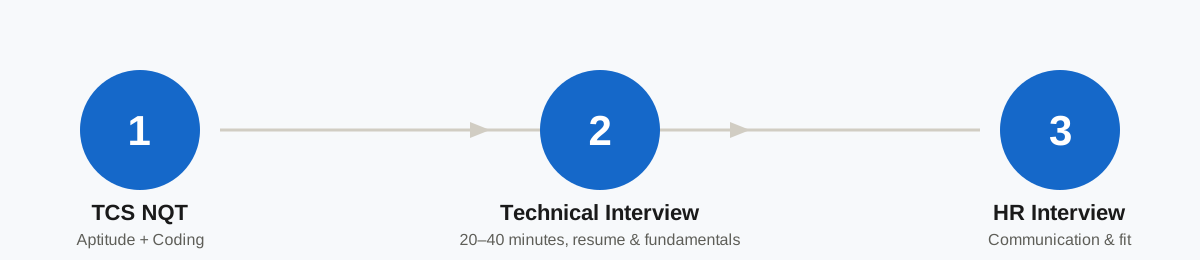
Most candidates go through three stages:
1. TCS NQT (aptitude + coding). Numerical ability, verbal ability, and reasoning sections, plus a coding section (usually 2 problems in a language of your choice). This is a screening round — clearing it gets you to the interview stage.
2. Technical interview. A single interviewer, usually 20–40 minutes, working from your resume: your final-year project, the languages/frameworks you've listed, and core subjects (DBMS, OOP, OS, networking basics). Expect at least one live coding or pseudocode question.
3. HR / managerial round. Communication, willingness to relocate, and basic culture-fit questions. This round rarely rejects candidates outright, but a weak answer to "why TCS" or visible hesitation about relocation can cost you.
Common TCS Technical Questions
Core CS fundamentals
Be ready to explain, in your own words: the four pillars of OOP (with an example from your own project, not a textbook definition), the difference between a process and a thread, normalization in DBMS (up to 3NF is usually enough), and how a JOIN works in SQL. Interviewers care more about whether you can explain a concept clearly than whether you memorized the exact definition. Since most TCS interviews run in Java, our Java interview questions guide and SQL interview questions guide cover both in more depth.
Your project
This is the part most freshers under-prepare for. Know your own project well enough to answer: "Why did you choose this tech stack?", "What was the hardest bug you fixed?", and "What would you do differently now?" If you can't explain a design decision in your own project, that's a bigger red flag than a missed coding question.
A coding question
Typically an easy-to-medium array/string problem (reverse a string, find duplicates, basic sorting) or a simple SQL query. TCS interviewers generally accept pseudocode or a coding language you're comfortable in — clarity of thought matters more than syntax perfection.
Common TCS HR Questions
"Tell me about yourself", "Why TCS?", "Where do you see yourself in 5 years?", "Are you willing to relocate?", and "Do you have any questions for us?" are asked in almost every HR round. These aren't difficult questions, but they're easy to answer badly under nerves — a rehearsed, specific answer beats a generic one every time. We've written a full breakdown of how to structure the "tell me about yourself" answer, since it's the one candidates stumble on most.
10 Questions TCS Almost Always Asks
Across the technical and HR rounds, these ten come up more than any others. Use this as a quick recap before you walk in.
1. Tell me about yourself. Current status (degree/branch) → one or two relevant projects or skills → why this role, in under 90 seconds. See our full breakdown of this answer for the exact structure.
2. Why do you want to join TCS? Skip generic praise like "it's a great company." Name something specific — a project domain, training program, or growth path — and connect it to your own goals.
3. Explain your final year project. Lead with the problem it solved and your specific contribution, not the tech stack. The tech stack is a footnote, not the headline.
4. What are your strengths and weaknesses? Pick a real weakness with a concrete example of how you're addressing it — a rehearsed "I work too hard" answer is an instant red flag to an interviewer who's heard it a hundred times.
5. Explain OOP concepts (encapsulation, inheritance, polymorphism, abstraction). Know the definitions cold, but have one real code example ready for each — interviewers often follow up with "can you show me an example?"
6. What is the difference between a process and a thread? A process has its own memory space; threads within the same process share memory. Be ready to explain multithreading basics too if you've listed it as a skill.
7. Reverse a string, or check if it's a palindrome. Practice writing this on paper, not just in an IDE — and talk through your logic out loud as you write, since that's what's actually being evaluated.
8. How do you handle pressure or tight deadlines? Use a real example — a project deadline, exam period, or team conflict — and focus on the specific action you took, not just how it felt.
9. Are you comfortable with relocation or shift timings? Answer honestly but affirmatively where you can. This is usually a screening question, not a technical one, and hesitation here can cost you more than a shaky coding answer.
10. Do you have any questions for us? Always have one or two ready — training structure, the team you'd be placed in, or growth path in the first year are safe, genuine options. Never say "no."
Practice a full TCS-style round before the real one
Run a timed AI mock interview with instant scoring on your answers — see exactly where you'd lose points.
Try a Mock Interview FreeYour Last Week Before the Interview
With limited time, prioritize in this order: (1) re-read your own resume and project until you can explain every line, (2) revisit OOP, DBMS, and one coding language you're confident in, (3) do a few timed mock rounds so the format itself isn't a surprise on the day. Practicing out loud — not just reading — is what actually reduces nerves, since TCS interviews are conversational, not written tests.
You can run a live-scored AI Mock Interview to practice the technical and HR rounds under time pressure, or use Flash Practice for a single high-impact question a day if you only have a few minutes to spare.
Frequently Asked Questions
What are the stages of the TCS interview process?expand_more
TCS NQT (aptitude and coding screening), a technical interview (20–40 minutes, resume- and fundamentals-driven), and an HR/managerial round covering communication and fit.
What technical topics does TCS ask about most?expand_more
The four pillars of OOP, process vs. thread, DBMS normalization up to 3NF, how a JOIN works in SQL, and a deep walkthrough of your own final-year project.
What HR questions come up in almost every TCS interview?expand_more
"Tell me about yourself," "Why TCS?," "Where do you see yourself in 5 years?," "Are you willing to relocate?," and "Do you have any questions for us?"
How should I spend my last week before a TCS interview?expand_more
Re-read your resume and project until you can explain every line, revisit OOP/DBMS and one coding language you're confident in, then run a few timed mock rounds so the format isn't a surprise on the day.
You Might Also Like