System Design Interview Questions for Freshers

Most fresher interviews don't include a full system design round — that's typically reserved for experienced hires. But product-based companies and some service companies do ask a scaled-down version: design a simple, well-known system like a URL shortener or a basic chat app, focused on whether you understand fundamental building blocks, not on production-scale architecture.
Do Freshers Really Need This?
If you're interviewing for a service-based company for a general developer role, you likely won't get a dedicated system design round. If you're interviewing for a product-based company, a startup, or any SDE role with "design" in the job description, expect at least a lightweight version of it. Either way, knowing the basics makes you noticeably stronger in technical interviews generally, since the same concepts come up when discussing your own projects.
Core Concepts to Know
Client-server basics. How a request travels from a browser/app to a server and back, and where a load balancer sits in that path.
Databases: SQL vs. NoSQL. When you'd reach for a relational database (structured data, relationships, transactions) versus a NoSQL store (flexible schema, high write throughput, simpler scaling).
Caching. Why you'd put a cache in front of a database, and the basic idea of cache invalidation (how do you know when cached data is stale?).
APIs. What makes an API RESTful, and the difference between GET, POST, PUT, and DELETE.
Scaling basics. The difference between scaling up (a bigger server) and scaling out (more servers behind a load balancer), and why most real systems eventually need the latter.
A Simple Framework for Any System Design Question
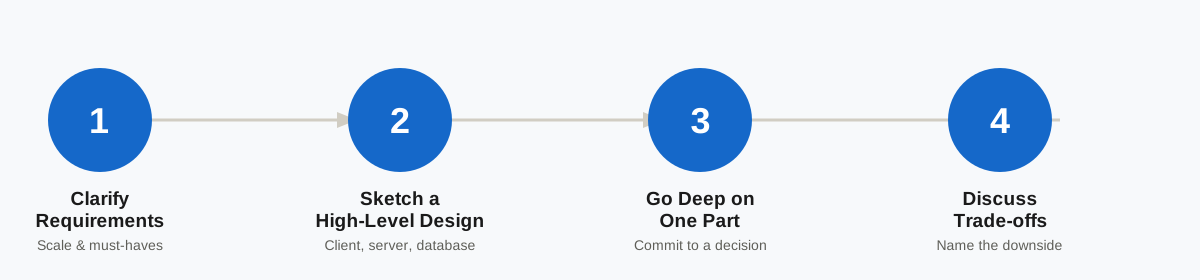
Don't jump straight to drawing boxes. Work through it in this order:
1. Clarify requirements. Ask what scale you're designing for, and what the must-have features are versus nice-to-haves. This alone signals maturity to the interviewer.
2. Sketch a high-level design. Client, server, database, and any obvious extra piece (cache, load balancer) — at a level a non-engineer could roughly follow.
3. Go deep on one or two parts. The interviewer will usually steer you toward the part they care about — commit to a decision there rather than listing every possible option.
4. Discuss trade-offs. Every design choice has a downside. Naming it ("this makes writes faster but reads more complex") shows you understand the trade-off, not just the term.
Worked Example: Design a URL Shortener
This is one of the most commonly asked beginner system design questions, precisely because it's small enough to fully reason through in 20–30 minutes.
Requirements: Given a long URL, return a short one. When someone visits the short URL, redirect them to the original.
High-level design: A client sends the long URL to a server, which generates a short code (often a hash or a counter encoded in base62), stores the mapping (short code → long URL) in a database, and returns the short URL. On visiting the short URL, the server looks up the code and issues a redirect.
Where it gets interesting: How do you generate short codes without collisions? (A counter is simpler and guarantees uniqueness; a hash is faster to reason about but needs collision handling.) Should reads be cached, given that redirects vastly outnumber creations? (Usually yes — this is a read-heavy system.) That's the kind of trade-off discussion interviewers are actually listening for.
Practice framing system design answers under time pressure
Flash Practice scores structure and clarity on a 60-second spoken answer — the same skill this framework needs.
Start Practicing FreeHow to Practice
System design is a spoken, whiteboard-style skill — reading about it isn't the same as practicing explaining it out loud under time pressure. Run through questions like this in a live-scored AI Mock Interview, or drill the underlying fundamentals (OOP, databases, APIs) with Flash Practice's daily questions.
Frequently Asked Questions
Do freshers actually get asked system design questions?expand_more
Usually only a scaled-down version, and mainly at product-based companies, startups, or SDE roles that mention "design" in the job description — general service-company roles typically skip a dedicated round.
What's a simple framework for answering any system design question?expand_more
Clarify requirements first, sketch a high-level design (client, server, database, and any obvious extra piece), go deep on one or two parts the interviewer steers toward, then discuss trade-offs.
How would you design a URL shortener?expand_more
A client sends a long URL to a server, which generates a short code (a counter or hash encoded in base62), stores the short-code-to-long-URL mapping in a database, and returns the short URL; visiting it looks up the code and redirects.
What's the difference between scaling up and scaling out?expand_more
Scaling up means using a bigger server; scaling out means adding more servers behind a load balancer. Most real systems eventually need to scale out since a single server has a ceiling.
You Might Also Like